Barbault's Basket: What July Is Really Telling Us
Everyone's circling July 19th like it's the day the world flips. I've been watching the buzz build for weeks, and honestly, I understand the pull because the astrology behind it is genuinely remarkable. But the more I dug into what's actually happening in the sky, and what André Barbault himself wrote about this period, the more I wanted to pump the brakes a little and give you the fuller picture.
Because here's the thing: the basket is real.
The moment is significant. But it's not quite the story that's been going around.
To understand why July matters, you first need to know who Barbault was. André Barbault (1921–2019) was a French mundane astrologer, not the horoscope-column variety, but the methodical, decades-long-career kind who spent his life tracking the outer planets (Saturn, Uranus, Neptune, Pluto) and mapping them against historical events. His predictions for the Soviet Union's collapse, the 2008 financial crisis, and a major global pandemic in 2020–2021 have made him difficult to dismiss. So when he wrote about 2026–2030 in his 2014 book, people rightfully paid attention.
What he actually said, though, is subtler than the viral framing suggests. While his book was written in French, the most accurately translated version is via Marjorie Orr:
"The peculiarity of the turning point of 2026–2030 is represented by the centrality of the Saturn-Neptune conjunction at the beginning of Aries… We are faced with the possibility of a change such as to make the terms 'change' or 'upheaval' seem too weak to define the breadth of what could transform in the known world."
Notice what he centers: not a date in July, but the Saturn-Neptune conjunction at 0° Aries which already happened in February 2026! We are already inside the thing Barbault was pointing to. The cycle didn't start on the 19th. We've been in it for months.
So what is Barbault's Basket, then, and why does July matter?
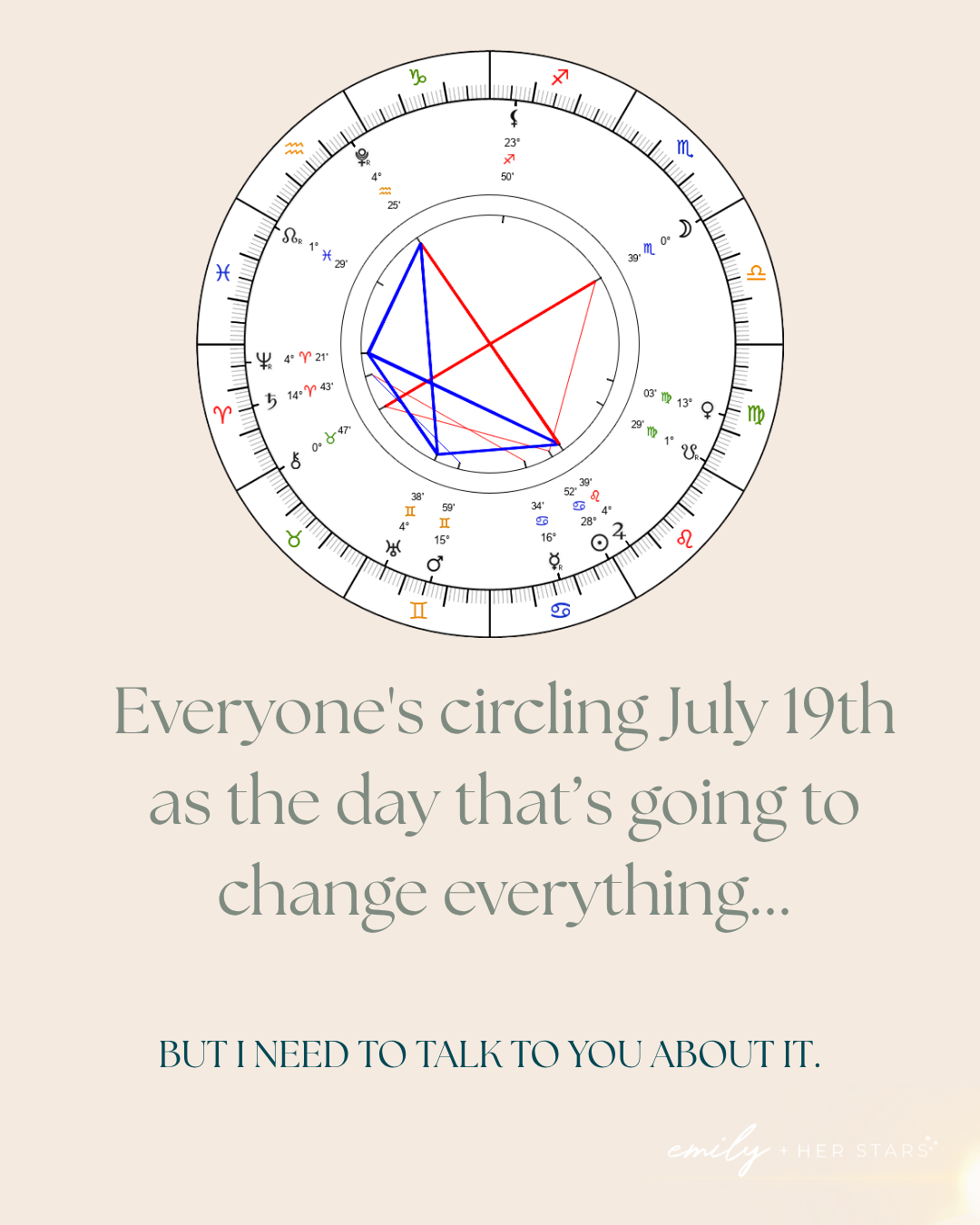
Between July 19–21, the sky forms a configuration so striking it actually looks like a basket on a chart. Four major planets are clustering at the exact same degree — 4° — in new signs, all aspecting one another in supportive, harmonious ways:
Pluto at 4° Aquarius
Neptune at 4° Aries
Uranus at 4° Gemini
Jupiter at 4° Leo — opposite Pluto, forming the lid
The Moon, moving opposite Chiron at 0° on the 21st, completes the picture as the handle. It's a genuinely rare shape, and it will recur in June 2027. The last time a configuration anything like this formed, archaeologists link it to the Uruk period in Mesopotamia which some consider the first true urban revolution in human history. We genuinely don't have modern precedent for what we're in and it feels exciting! Is it AI, or globalization? Is it a shift in power structures? I tend to be more optimistic that it’s an opportunity for us to choose the future you want.
July, then, is a peak within the larger cycle less a starting gun and more a match being struck on kindling that's been laid since February. The fire didn't begin with the match.
Which brings me to how this is actually likely to feel.
Outer planets don't move like Mercury. There's no waking up on July 20th feeling like a switch flipped. This kind of energy tends to surface slowly, boiling up from the subconscious until it spills over — like the moment you realize you've been tolerating something for years and suddenly, with startling clarity, you absolutely cannot anymore. If you have placements at 4° Libra or Sagittarius in your natal chart, you'll feel this configuration's shape even more personally.
And here's where I want to be the slightly uncool voice in the room: a window is not a guarantee. This alignment describes conditions and opens potential. It cannot force transformation to happen. I've watched a lot of "this changes everything" energy move through the astrology world over the years — some of it did, and some of it was wishful thinking in planetary clothing. This one feels genuinely different to me. But we won't know how accurately any of this was predicted until we're standing on the other side of 2030 looking back.
What I do know is that we're in unprecedented territory, and unprecedented doesn't have to mean catastrophic. Humans have survived floods, wars, and collapses of the known world before. This could just as easily be a window toward something new — if we choose to participate in building it rather than simply watching or spiraling.
Stay awake to it. Don't go back to sleep, but don't sit in a petri dish of anxiety either. The basket is open. What we put in it is still up to us.
Chart interpretation by Emily + Her Stars. André Barbault quote translated via Marjorie Orr.